
Sunday, September 21, 2008

Conrad's Preface to The Nigger of the Narcissus
A work that aspires, however humbly, to the condition of art should carry its justification in every line. And art itself may be defined as a single-minded attempt to render the highest kind of justice to the visible universe, by bringing to light the truth, manifold and one, underlying its every aspect. It is an attempt to find in its forms, in its colors, in its light, in its shadows, in the aspects of matter and in the facts of life what of each is fundamental, what is enduring and essential-their one illuminating and convincing- quality -the very truth of their existence. The artist, then, like the thinker or the scientist, seeks the truth and makes his appeal. Impressed by the aspect of the world the thinker plunges into ideas, the scientist into facts-whence, presently, emerging they make their appeal to those qualities of our being that fit us best for the hazardous enterprise of living. They speak authoritatively to our common-sense, to our intelligence, to our desire of peace or to our desire of unrest; not seldom to our prejudices, sometimes to our fears, often to our egoism-but always to our credulity. And their words are heard with reverence, for their concern is with weighty matters: with the cultivation of our minds and the proper care of our bodies, with the attainment of our ambitions, with the perfection of the means and the glorification of our precious aims.
It is otherwise with the artist.
Confronted by the same enigmatical spectacle the artist descends within himself, and in that lonely re,-ion of stress and strife, if he be deserving and fortunate, he finds the terms of his appeal. His appeal is made to our less obvious capacities: to that part of our nature which, because of the warlike conditions of existence, is necessarily kept out of sight within the more resisting and hard qualities-like the vulnerable body within a steel armor. His appeal is less loud, more profound, less distinct, more stirring-and sooner forgotten. Yet its effect endures forever. The changing wisdom of successive generations discards ideas, questions facts,, demolishes theories. But the artist appeals to that part of our being which is not dependent on wisdom; to that in us which is a gift and not an acquisition-and, therefore, more permanently enduring. He speaks to our capacity for delight and wonder, to the sense of mystery surrounding our lives; to our sense of pity, and beauty, and pain; to the latent feeling of fellowship with all creation-and to the subtle but invincible conviction of solidarity that knits together the loneliness of innumerable hearts, to the solidarity in dreams, in joy, in sorrow, in aspirations, in illusions, in hope, in fear, which binds men to each other, which binds to-ether all humanity-the dead to the living and the living to the unborn.
It is only some such train of thought, or rather of feeling, that can in a measure explain the aim of the attempt, made in the tale which follows, to present an unrestful episode in the obscure lives of a few individuals out of all the disregarded multitude of the bewildered, the simple and the voiceless. For, if any part of truth dwells in the belief confessed above, it becomes evident that there is not a place of splendor or a dark corner of the earth that does not deserve, if only a passing glance of wonder and pity. The motive then, may be held to justify the matter of the work; but this preface, which is simply an avowal of endeavor, cannot end here-for the avowal is not yet complete.
Fiction-if it at all aspires to be art-appeals to temperament. And in truth it must be, like painting, like music, like all art, the appeal of one temperament to all the other innumerable temperaments whose subtle and resistless power endows passing events with their true meaning, and creates the moral, the emotional atmosphere of the place and time. Such an appeal to be effective must be an impression conveyed through the senses; and, in fact, it cannot be made in any other way, because temperament, whether individual or collective, is not amenable to persuasion. All art, therefore, appeals primarily to the senses, and the artistic aim when expressing itself in written words must also make its appeal through the senses, if its high desire is to reach the secret spring of responsive emotions. It must strenuously aspire to the plasticity of sculpture, to the color of painting, and to the magic suggestiveness of music-which is the art of arts. And it is only through complete, unswerving devotion to the perfect blending of form and substance; it is only through an unremitting never-discouraged care for the shape and ring of sentences that an approach can be made to plasticity, to color, and that the light of magic suggestiveness may be brought to play for an evanescent instant over the commonplace surface of words: of the old, old words, worn thin, defaced by ages of careless usage.
The sincere endeavor to accomplish that creative task, to go as far on that road as his strength will carry him, to go undeterred by faltering, weariness or reproach, is the only valid justification for the worker in prose. And if his conscience is clear, his answer to those who in the fullness of a wisdom which looks for immediate profit, demand specifically to be edified, consoled, amused; who demand to be promptly improved, or encouraged, or frightened, or shocked, or charmed, must run thus:-My task which I am trying to achieve is, by the power of the written word to make you hear, to make you feel-it is, before all, to make you see. That-and no more, and it is everything. If I succeed, you shall find there according to your deserts: encouragement, consolation, fear, charm-all you demand-and, perhaps, also that glimpse of truth for which you have forgotten to ask.
To snatch in a moment of courage, from the remorseless rush of time, a passing phase of life, is only the beginning of the task. The task approached in tenderness and faith is to hold up unquestioningly, without choice and without fear, the rescued fragment before all eyes in the light of a sincere mood. It is to show its vibration, its color, its form; and through its movement, its form, and its color, reveal the substance of its truth-disclose its inspiring secret: the stress and passion within the core of each convincing moment. In a single-minded attempt of that kind, if one be deserving and fortunate, one may perchance attain to such clearness of sincerity that at last the presented vision of regret or pity, of terror or birth, shall awaken in the hearts of the beholders that feeling of unavoidable solidarity; of the solidarity in mysterious origin, in toil, in joy, in hope, in uncertain fate, which binds men to each other and all mankind to the visible world.
It is evident that he who, rightly or wrongly, holds by the convictions expressed above cannot be faithful to any one of the temporary formulas of his craft. The enduring part of them-the truth which each only imperfectly veils -should abide with him as the most precious of his possessions ' but they all: Realism, Romanticism, Naturalism, even the unofficial sentimentalism (which like the poor, is exceedingly difficult to get rid of), all these gods must, after a short period of fellowship, abandon him-even on the very threshold of the temple-to the stammerings of his conscience and to the outspoken conscious- ness of the difficulties of his work. In that uneasy solitude the supreme cry of Art for Art itself, loses the exciting ring of its apparent immorality. It sounds far off. It has ceased to be a cry, and is heard only as a whisper, often incomprehensible, but at times and faintly encouraging.
Sometimes, stretched at ease in the shade of a roadside tree, we watch the begin to wonder motions of a laborer in a distant field, and after a time, movements of his languidly as to what the fellow may be at. We watch the body, the waving of his arms, we see him bend down, stand up, hesitate, begin again. It may add to the charm of an idle hour to be told the purpose of his exertions. If we know he is trying to lift a stone, to dig a ditch, to uproot a stump, we look with a more real interest at his efforts; we are disposed to condone the jar of his agitation upon the restfulness of the landscape; and even, if in a brotherly frame of mind, we may -bring ourselves to forgive his failure. We understood his object, and, after all, the fellow has tried, and perhaps he had not the strength-and perhaps he had not the knowledge. We forgive, go on our way-and forget.
And so it is with the workman of art. Art is long and life is short, and success is very far off. And thus, doubtful of strength to travel so far, we talk a little about the aim-the aim of art, which, like life itself, is inspiring, difficult-obscured by mists. It is not in the clear logic of a triumphant conclusion; it is not in the unveiling of one of those heartless secrets which are called the Laws of Nature. It is not less great, but only more difficult.
To arrest, for the space of a breath, the hands busy about the work of the earth, and compel men entranced by the sight of distant goals to glance for a moment at the surrounding vision of form and color, of sunshine and shadows; to make them pause for a look, for a sigh, for a smile-such is the aim, difficult and evanescent, and reserved only for a few to achieve. But sometimes, by the deserving and the fortunate, even that task is accomplished And when it is accomplished-behold!- all the truth of life is there: a moment of vision, a sigh, a smile-and the return to an eternal rest.


"…every animal is in the world like water in water."
"Animals, since they eat one another, are of unequal strength, but there is never anything between them except that quantitative difference. The lion is not king of the beasts: in the movement of the waters he is only a higher wave overturning the other, weaker waves." G Bataille


Saturday, September 20, 2008


Friday, September 19, 2008


Degrees of separation - full cycle
Peddling in images, how can I not post Blur’s iconic Julian Opie cover The Best Of without showing Queens Hot Space? You could just picture this in 1982 on vinyl with it’s metallic inks and fluoro colors. It would have popped right off the walls. Zapping your very eyeballs. But even more classic is The Beatles Avedon. I remember staring at this as a child in wonder.


Thursday, September 18, 2008


Wednesday, September 17, 2008


Viral Bibliomancy
1. Grab the nearest book.
2. Open the book to page 23.
3. Find the fifth sentence.
4. Post the text of the sentence in your journal...along with these instructions.
'The Fifth Monarchists were an anti-Cromwellian movement of anything between 20,000 - 40,000 armed men, taking their inspiration from the profit Daniel and the Book of Revelation, who believed the existing order would pass away in 1666.'
You must find ones porcupine!

In Parerga und Paralipomena, published in 1851, Arthur Schopenhauer created a parable about the dilemma faced by porcupines in cold weather. He described a “company of porcupines” who “crowded themselves very close together one cold winter’s day so as to profit by one another’s warmth and so save themselves from being frozen to death. But soon they felt one another’s quills, which induced them to separate again.” And so on. The porcupines were “driven backwards and forwards from one trouble to the other,” until they found “a mean distance at which they could most tolerably exist.”

Gordon
"Near them their sisters three, the Gorgons, winged
With snakes for hair— hated of mortal man—"

With snakes for hair— hated of mortal man—"

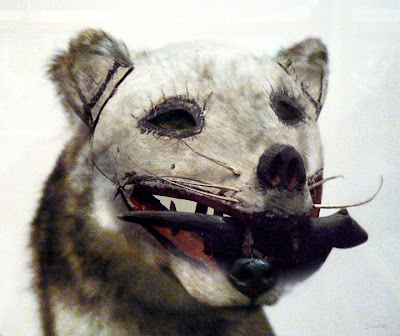
Wolfman's wolve
That day the Wolf-Man rose up from his couch particularly tired. He knew that Freud had a genius for brushing up against the truth and passing it by, then filling the void with associations. He knew that Freud knew nothing about wolves, or anuses for that matter. The only thing Freud understood was what a dog is, and a dogs tail. It wasn't enough. It wouldn't be enough.

Super normal?

GILLES DELEUZE: We do not use the terms “normal” or “abnormal”. All societies are rational and irrational at the same time. They are perforce rational in their mechanisms, their cogs and wheels, their connecting systems, and even by the place they assign to the irrational. Yet all this presupposes codes or axioms which are not the products of chance, but which are not intrinsically rational either. It’s like theology: everything about it is rational if you accept sin, immaculate conception, incarnation. Reason is always a region cut out of the irrational — not sheltered from the irrational at all, but a region traversed by the irrational and defined only by a certain type of relation between irrational factors. Underneath all reason lies delirium, drift. Everything is rational in capitalism, except capital or capitalism itself. The stock market is certainly rational; one can understand it, study it, the capitalists know how to use it, and yet it is completely delirious, it’s mad. It is in this sense that we say: the rational is always the rationality of an irrational. Something that hasn’t been adequately discussed about Marx’s *Capital* is the extent to which he is fascinated by capitalists mechanisms, precisely because the system is demented, yet works very well at the same time. So what is rational in a society? It is — the interests being defined in the framework of this society — the way people pursue those interests, their realisation. But down below, there are desires, investments of desire that cannot be confused with the investments of interest, and on which interests depend in their determination and distribution: an enormous flux, all kinds of libidinal-unconscious flows that make up the delirium of this society. The true story is the history of desire. A capitalist, or today’s technocrat, does not desire in the same way as a slave merchant or official of the ancient Chinese empire would. That people in a society desire repression, both for others and *for themselves*, that there are always people who want to bug others and who have the opportunity to do so, the “right” to do so, it is this that reveals the problem of a deep link between libidinal desire and the social domain. A “disinterested” love for the oppressive machine: Nietzsche said some beautiful things about this permanent triumph of slaves, on how the embittered, the depressed and the weak, impose their mode of life upon us all.


Tuesday, September 16, 2008

Monday, September 15, 2008


Nina we love!
Found a €1 poster of Nina in the Mauer park flea market on Sunday. I thought they only sold fleas at these markets. You know, like for your dog or cat if he or she needed any, but apparently you can get all sorts of good stuff besides fleas.
Cosma Shiva Hagen
Zzz.....
I had a look back at this blog as it's been just over a year since it was started! Probably a quarter of the Youtube videos have been removed. WHY? Who posts them then deletes them? Or is it Youtube? Most videos I had chosen had been posted up on Youtube for years which is why i thought they would be safe from removal. I replaced what i could but it will be a graveyard soon! Why bother? My understanding was that anything up on Youtube before the Google take over could stay up, but tons of cracking good stuff is now gone, probably for good, which is very sad indeed, and it's become just a place for people to show themselves in their bedrooms jumping up and down on their beds and doing karaoke! Who cares? I may pack this in when the free blog space ends........hmmm?
Whoever is out there, thanks for having a look in. Good to know somebody appreciates the effort, even if it is all just meaningless fun! Cheers
Whoever is out there, thanks for having a look in. Good to know somebody appreciates the effort, even if it is all just meaningless fun! Cheers


Subscribe to:
Posts (Atom)